Our sun, heat and winter storm season wear a roof down quietly. Here are the warning signs to watch, and the point where a repair becomes a replacement.

Los Angeles roofs do not fail all at once. They wear down quietly, season after season, under some of the hardest conditions in the country. By the time most homeowners notice a stain on the ceiling, the real damage has been building for years. A good roofing contractor in Los Angeles will tell you that the roof was sending signals long before the leak ever arrived.
The upside is that those signals are easy to read once you know what to look for. This guide walks through how our Southern California weather ages a roof, the warning signs worth watching, and the point where a simple repair turns into a full replacement.
Southern California is harder on roofs than it looks
The sunshine that makes Los Angeles so pleasant is tough on a roof. Day after day of strong ultraviolet light dries out asphalt shingles, cracks their protective coating, and bakes the oils out of the material until it turns brittle. Heat makes it worse. As a roof warms up by day and cools at night, it expands and contracts, and that constant movement slowly loosens seams, nails, and flashing.
Then there is the water. Our long dry spells lull people into ignoring the roof, and then winter storm season arrives in force, sometimes with an atmospheric river dumping months of rain in a few days. A roof that was quietly weakened all summer suddenly has to keep that water out. Closer to the coast, from the beach cities inland to Inglewood, salt air and the marine layer add moisture that speeds up wear, while shaded north facing slopes can grow moss and algae that hold water against the surface.
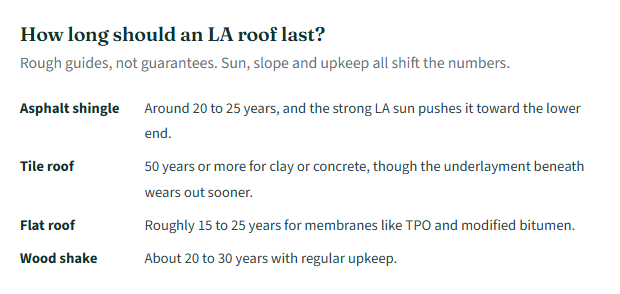
How long should your roof last?
No roof lasts forever, and the material matters more than anything else. Knowing roughly where your roof sits on its lifespan is the first step in deciding whether to maintain it, repair it, or start planning for a replacement.
The warning signs your roof is asking for help
You do not need to climb up to spot trouble. Many of the clearest warnings show up from the ground or from inside the house.
On the outside, look for shingles that are curling at the edges, cracked, bald, or missing altogether, and check your gutters for a buildup of the sandy granules that shingles shed as they wear out. Dark streaks, moss, or a sagging line along the ridge all point to deeper problems.
Inside, water stains on ceilings or walls, peeling paint, a musty smell in the attic, or daylight coming through the roof boards mean water is already getting in. A sudden jump in your cooling bill can be a sign the roof has lost its ability to reflect heat.
If you notice any of these, the smart move is not to panic but to schedule a roof inspection before the next storm turns a small problem into an expensive one.
When a repair is enough, and when it is time to replace
Not every problem means a new roof. If the damage is limited to a small area, the flashing around a vent or a handful of shingles after a windy night, and the rest of the roof is sound and still within its expected life, a targeted repair is usually the right call and the cheaper one.
Replacement makes more sense when the picture is bigger. A roof near the end of its lifespan, damage spread across a wide area, repeated leaks in different spots, or layers of patch jobs on top of patch jobs are all signs that repairs are only buying time. At that point many homeowners start pricing a roof replacement in Los Angeles, and the earlier you plan for it, the less likely you are to be forced into a rushed decision in the middle of a storm.
Choosing a roofing contractor in Los Angeles you can trust
The roofer you hire matters as much as the roof itself, because a poor installation can undo even the best materials. Start with the basics. Make sure the contractor is licensed, which in California means holding the C 39 roofing classification, and that they carry current insurance so you are not on the hook if someone is hurt on your property. Ask for a written estimate after a real inspection, references from recent local jobs, and a clear warranty on both the work and the materials.
Local and family run shops often stand out here, because their reputation in the neighborhood is everything. Blue Skyline Roofing is one example, a family owned LA roofing contractor that has kept its work in house across three generations rather than handing it to subcontractors. Whoever you choose, a roofer who takes the time to explain your options is worth far more than the lowest bid on the page.
The bottom line
A roof is easy to forget until it fails, and in Los Angeles the weather is working on it every single day. A few minutes spent checking for warning signs, a yearly look from a professional, and a quick repair when something is off will add years to its life and spare you the worst kind of surprise.
When the day comes that a repair is no longer enough, lean on a roofer who knows LA homes and will give you a straight answer. A trusted local name like Blue Skyline Roofing can walk you through whether it is time to repair or replace, and help you protect the biggest investment you own.
Frequently asked questions
How often should I have my roof inspected?
About once a year, and again after any major storm. Catching a small issue early is far cheaper than repairing the water damage a hidden leak can cause.
How long does a roof last in Los Angeles?
It depends on the material. An asphalt shingle roof often lasts around 20 to 25 years, tile can last 50 years or more, and flat roofs tend to run 15 to 25 years. The strong LA sun can push the lower end even shorter.
What are the first signs I need a new roof?
Curling, cracked, or missing shingles, piles of granules in the gutters, water stains on the ceiling, daylight in the attic, and a roof that is simply past its expected age are the most common early signs.
Can a roof leak be repaired, or do I need a full replacement?
Often a repair is enough when the damage is localized and the roof still has life left. Widespread damage, repeated leaks, or a roof near the end of its lifespan usually point toward replacement. An inspection is the only way to know for sure.
How much does a new roof cost?
It varies widely with the size of the roof, the material, the pitch, and access. A reputable roofer gives you a free written estimate after inspecting the roof. Be wary of any firm that quotes a price without looking at it first.
Should I fix my roof before selling my home?
A sound roof reassures buyers and can keep a sale from stalling during inspection. At a minimum, have the roof looked at so you know its condition and can price your home accordingly.
What does a C 39 license mean?
In California, C 39 is the state license classification for roofing contractors. Always confirm your roofer holds an active, valid license and carries proper insurance before work begins.
Does coastal air affect my roof?
Yes. Nearer the coast, salt air and the marine layer add moisture that speeds up wear, and shaded north facing slopes can grow moss or algae that trap water against the roof.