
What Los Angeles and California employers need to know about Ban the Box, FCRA and ICRAA to screen new hires legally without slowing the process down.
A single misstep in a background check can cost a Los Angeles employer far more than a bad hire. California has some of the strictest screening rules in the country, and in 2024 Los Angeles County added another layer on top. Get the order wrong, skip a notice, or ask the wrong question too early, and you can face penalties or a lawsuit before the new hire even starts.
The good news is that compliant hiring is a process, not a guessing game. Once you understand how employee background screening works in California, you can run thorough checks that hold up legally and still keep good candidates moving. Here is what Los Angeles and California employers need to know.
Employee background screening sits under three layers of law
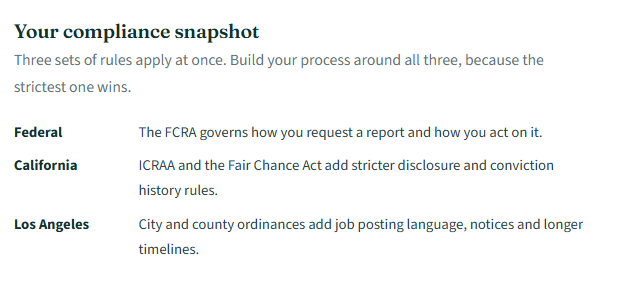
Most employers picture employee background screening as one simple step. In California it is governed by three sets of rules at the same time, and the strictest one always applies.
At the federal level, the Fair Credit Reporting Act, or FCRA, sets how you request a report from a screening agency and what you must do before you turn anyone down based on it. California then layers on the Investigative Consumer Reporting Agencies Act, known as ICRAA, which adds its own disclosure rules, and the Fair Chance Act, the state Ban the Box law that controls when and how you can look at conviction history. On top of all that, the City and County of Los Angeles have their own fair chance ordinances with extra steps.
Because these rules stack, following only federal law is not enough. For a plain language breakdown of how requirements differ by jurisdiction, see California’s state by state screening rules.
Ban the Box changed the order of hiring
California’s Fair Chance Act applies to almost every employer with five or more employees, and it changed the order of the hiring process. You cannot ask about an applicant’s conviction history on an application, in an interview, or at any point before you make a conditional job offer.
Only after that offer can you run a check that includes conviction records. If something turns up that gives you pause, you cannot simply withdraw the offer. The law requires an individualized assessment, which means weighing the nature and seriousness of the offense, how much time has passed, and whether it genuinely relates to the duties of the job.
If you still lean toward rescinding the offer, the applicant gets written notice and at least five business days to respond before you make a final decision. Rushing this step is one of the most common and most expensive mistakes employers make.
What Los Angeles adds on top
If any of your employees work in Los Angeles, there is more to track. The City of Los Angeles has had its Fair Chance Initiative for Hiring Ordinance since 2017, and on September 3, 2024 the County added its own Fair Chance Ordinance for Employers.
The county ordinance reaches employers with five or more employees who do business in the unincorporated areas of Los Angeles County, and it is detailed. Job postings must state that qualified applicants with arrest or conviction records will be considered. Employers have to post notices at the workplace and online, give specific written notice before reviewing any criminal history after an offer, keep records for four years, and avoid retaliating against applicants who speak up.
The penalties climb fast, from five thousand dollars for a first violation to twenty thousand for repeat ones, and applicants can sue directly. If you hire anywhere in the county, confirm whether your worksite sits in an unincorporated area, because that one detail decides whether these extra rules apply.

Getting the FCRA paperwork right
The FCRA side is mostly about paperwork, and small errors cause real problems. Before you run any check through a screening agency, you need a clear standalone disclosure that says a report will be obtained, and you need the applicant’s written permission. The disclosure cannot be buried inside the application or padded with extra language.
If the report leads you toward a no, the FCRA adds its own notice steps on top of the state ones. You send a pre adverse action notice with a copy of the report and a summary of the applicant’s rights, give them time to respond, and only then send a final adverse action notice. Working from templates that a court has never vetted is risky, which is why most employers lean on a screening partner to handle these notices correctly.
The checks that go beyond criminal records
Criminal history gets the most attention, but a complete background check covers much more, and each piece has its own rules. Identity and work authorization checks, such as a Social Security number trace along with Form I 9 and E Verify, confirm that a candidate is who they say they are and is cleared to work. Employment, education, and professional license verification checks that the resume holds up.
For many roles you also need drug and alcohol testing and occupational health screening, and for anyone who drives on the job, a motor vehicle record. Credit checks are allowed only for specific positions where California law permits them. The aim is to match the checks to the role rather than running everything on everyone, which keeps the process fair, faster, and far easier to defend.
How to screen fast and stay compliant
All of this can sound like a reason to slow down, but the opposite is true for employers who set it up well. The rules reward a consistent, documented process, and the quickest way to get there is to work with a specialist rather than piecing it together in house.
A screening firm that is accredited by the Professional Background Screening Association and knows California and Los Angeles rules can build the disclosures, notices, and individualized assessment steps right into your workflow. A long established provider such as Employers Choice Screening acts as a compliant background screening partner that keeps turnaround quick while making sure every legal box is ticked, so hiring managers are not left reading statutes between interviews.
The bottom line
Compliant hiring in California is not about doing fewer checks. It is about doing them in the right order, with the right notices, and with a clear record at every step. Employers who treat employee background screening as a defined process, rather than a last minute scramble, protect themselves and treat candidates fairly at the same time.
If keeping up with Ban the Box, the FCRA, and a new county ordinance feels like a second job, that is the signal to hand it to a partner who does this all day. A firm like Employers Choice Screening can carry the compliance load so your team can focus on finding the right people.
Frequently asked questions
When can I run a background check on a California applicant?
Not until after you make a conditional job offer. Under the Fair Chance Act you cannot ask about conviction history on an application or in an interview, so the check that includes criminal records comes after the offer.
What is Ban the Box?
It is the common name for California’s Fair Chance Act, which removes conviction history questions from the early hiring stages. Employers with five or more employees must make a conditional offer first, then run an individualized assessment before acting on any record.
Does the Los Angeles County ordinance apply to my business?
It applies if you have five or more employees and anyone works in the unincorporated areas of Los Angeles County. It took effect on September 3, 2024 and adds job posting language, notices, and recordkeeping. Check whether your worksite is unincorporated.
What does the FCRA require before I run a check?
A clear standalone written disclosure that a report will be obtained, plus the applicant’s written authorization, handled through an accredited screening agency. The disclosure cannot be mixed into the job application.
What is an individualized assessment?
It is a documented review of whether a conviction actually relates to the job, weighing the nature of the offense, how long ago it happened, and the duties involved. California requires it before you deny someone based on conviction history.
What happens if the report makes me want to withdraw an offer?
You send a pre adverse action notice with a copy of the report and a summary of rights, give the applicant at least five business days to respond, and only then send a final adverse action notice.
How long do background checks take?
It depends on scope. Identity and criminal searches are often fast, while employment and education verifications rely on third parties and can take longer. A good provider gives you a realistic turnaround up front.
What checks should employers consider beyond criminal records?
Identity and work authorization, employment and education verification, drug and alcohol testing, occupational health, and a motor vehicle record for drivers. Credit checks are limited to specific roles that California law allows.